
Facebook

Twitter (X)

Instagram

Somali Magazine - People's Magazine
U.S.-backed airstrikes and expanded ground offensives are changing the direction of Somalia’s long battle against al-Shabab, according to government officials. Authorities say recent operations have helped Somali forces reclaim key areas, weaken the group’s leadership, and dismantle parts of its bomb-making network. These developments come at a crucial time, as Somalia takes on greater responsibility for its own security while African Union peacekeeping forces gradually reduce their presence.
Al-Shabab first emerged in the mid-2000s as the armed wing of the Islamic Courts Union before later pledging allegiance to al-Qaida. At its height, the group controlled large parts of southern and central Somalia, including areas of the capital, Mogadishu. In 2011, African Union troops pushed the militants out of much of the capital. However, the group adapted quickly, shifting to guerrilla warfare tactics such as suicide bombings, roadside explosions, and targeted assassinations. Over the years, it has continued to raise significant funds through taxation and extortion in areas under its influence.
The United States has been involved in Somalia’s counterterrorism efforts for more than a decade, mainly through airstrikes. In 2020, then-President Donald Trump ordered most U.S. troops withdrawn from Somalia. Two years later, President Joe Biden approved the redeployment of U.S. forces, restoring a more consistent advisory and counterterrorism presence. Since then, coordination between Somali forces and U.S. Africa Command has increased.
Somali officials say their troops have retaken several areas that had been under al-Shabab’s control for years, including parts of Lower Shabelle, Hiiraan, Middle Shabelle, and Jubbaland. They report successful operations in towns that once served as militant strongholds, as well as joint missions involving regional forces and the U.S.-trained Danab special forces. According to the government, dozens of militants have been killed and vehicles seized during these operations. However, access to many contested areas remains limited, making it difficult to independently confirm all claims.
Airpower has played a major role in these recent gains. U.S. Africa Command, known as United States Africa Command, says it conducts precision airstrikes targeting militant leaders, training camps, and weapons facilities, often based on intelligence shared by Somali authorities. Officials say some of these strikes have destroyed improvised explosive device factories and prevented car bombs from being deployed.
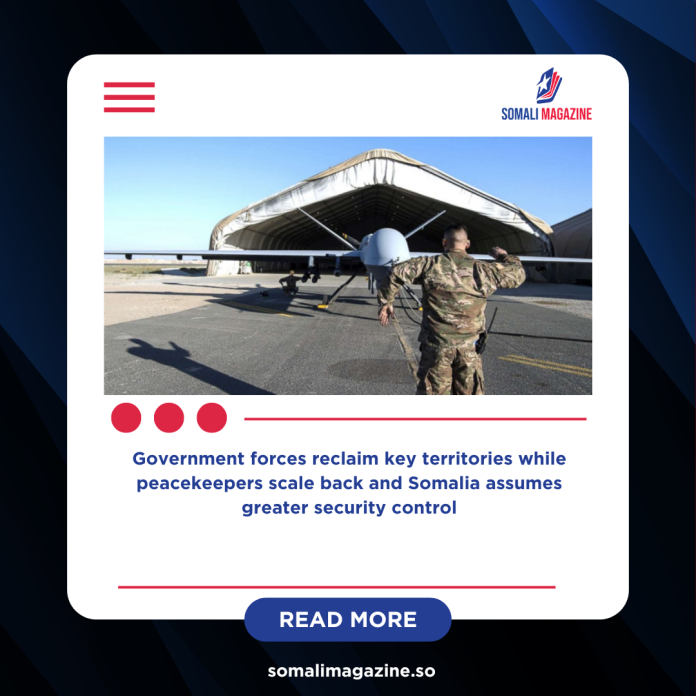
Security analysts in Mogadishu say expanded drone surveillance has changed the battlefield. In earlier stages of the conflict, Somali government forces and al-Shabab fighters often relied on similar ground weapons. What the government lacked was sustained air support and consistent aerial monitoring. With improved drone coverage, forces can now detect hidden militant bases and supply routes that were previously difficult to reach. Once those positions are hit from the air, it becomes easier for ground troops to move in and secure territory.
The timing of the renewed offensive is significant. The African Union Transition Mission in Somalia is gradually scaling back its operations, placing more responsibility on Somali security forces. Analysts say this shift makes continued air support and intelligence cooperation with international partners especially important. At the same time, Somalia faces other challenges, including drought linked to climate change, political tensions between federal and regional leaders, and funding shortages affecting both security and humanitarian programs.
Experts caution that military victories alone are not enough. In past offensives, government forces have sometimes reclaimed territory only for al-Shabab to return after troops withdrew or failed to establish stable local governance. Maintaining control will require rebuilding infrastructure, restoring services, and ensuring security in newly retaken areas.
Somali authorities say thousands of al-Shabab fighters have been killed since the intensified campaign began, though those figures have not been independently verified. While government forces appear to have expanded their reach in several regions, al-Shabab remains active across parts of central and southern Somalia and continues to carry out attacks, including in Mogadishu.
The government says it plans to combine military operations with reconstruction efforts, including rebuilding homes and delivering aid in reclaimed towns. Officials believe this approach will help prevent the militants from regaining influence. Still, al-Shabab remains one of Africa’s most resilient armed groups, and the road to lasting stability will depend on Somalia’s ability to secure and effectively govern the territory it has fought hard to reclaim.