
Facebook

Twitter (X)

Instagram

Somali Magazine - People's Magazine
On a bright morning in Kahda, a district on the southern edge of Mogadishu, a young mother stands at the immunization desk without the small paper card that once tracked her child’s vaccines. For years, that fragile card was the only proof a child had received routine immunizations. If it was lost during eviction, floods, or displacement, health workers had no reliable way to confirm which doses had already been given. Nurses often had to rely on a mother’s memory, search through thick paper registers, repeat injections, or mark a child as “zero-dose” because there was no record.
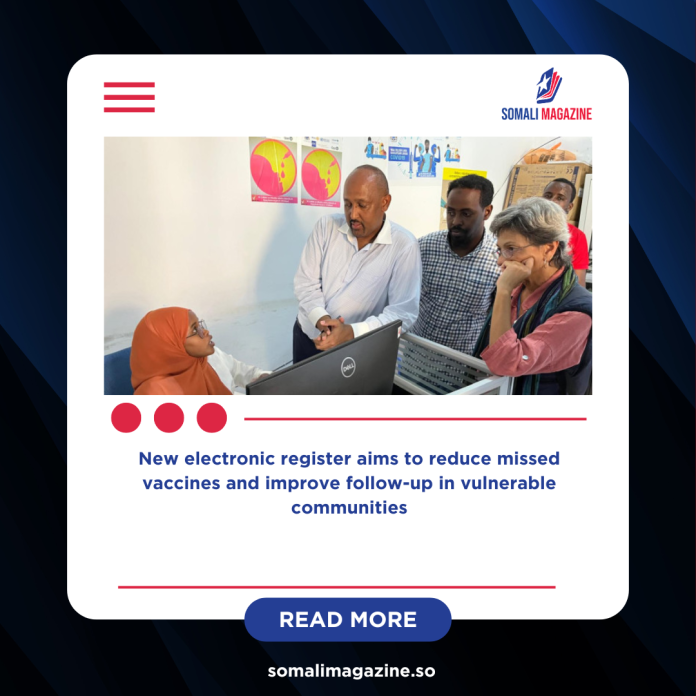
Today, things are starting to change. Nurse Naima Muse turns from a crying toddler to a desktop computer and types in a number. Within seconds, the child’s immunization history appears on the screen. “Before, if a mother lost the card, we had nothing,” she says. “Now, we just search.”
The system she uses is the Electronic Immunization Register (EIR), introduced in 2025 in 14 health facilities across the Banadir region. Each vaccinated child is assigned a unique identification number. Their vaccine history is stored digitally, and caregivers receive SMS reminders when the next dose is due. Health officials at district, state, and federal levels can see updated data almost in real time. The Ministry of Health plans to expand the system to more than 80 facilities nationwide by 2026.
In Somalia, where paper records have long filled the gap left by weak institutions, this shift is significant. Kahda district, which hosts many internally displaced families fleeing conflict and climate disasters, has struggled with overcrowded camps and limited services. Many mothers move frequently and often lose important documents, including vaccination cards. Without proper records, children can miss doses or receive unnecessary repeat vaccines.
Somalia has faced serious immunization challenges. Years of conflict, drought, and fragile infrastructure have left a large number of children without routine vaccines. Disease outbreaks such as measles and diphtheria continue to affect communities. In the first eleven months of 2025 alone, more than 3,000 suspected diphtheria cases and over 130 related deaths were reported nationwide. In such conditions, paper-based systems are not just inconvenient — they are unreliable.
The new digital register is built on DHIS2, an open-source health information platform used in many countries. It includes a mobile application for frontline workers, dashboards for managers, and automated SMS reminders for caregivers. Technical support comes from international partners, but the Somali government owns and manages the system.
According to Abdirahman Mohamed Mohamud, data manager for the Expanded Program on Immunization at the Federal Ministry of Health, the system allows officials to monitor vaccination data at every level. “When a child is vaccinated, the data entered can be seen at district, regional, state, and national levels,” he explains. This makes it easier to identify children who have not received any vaccines and to follow up quickly.
If a mother takes her child to another participating facility, staff can retrieve the record using the unique ID number. This reduces duplicate entries and helps maintain accurate schedules. However, the system is not yet perfect. Electricity cuts and weak internet connections mean staff sometimes record information on paper and upload it later. For now, digital and paper systems run side by side.
Data privacy is another concern. Officials say access to the system is controlled, with different levels of permission. Only authorized users can enter or view specific data. Mothers are asked to give consent before their child’s information is recorded and before SMS reminders are activated.
Some caregivers welcome the change. Halimo Adan, a mother of four, initially worried she would be charged for the reminder messages. “Later they told me it is a new system to help children,” she says. She appreciates the reminders because her family moves often. Maryan Ahmed, another mother, says the clinic quickly found her son’s record when she visited without a card. Still, she wonders who else can see her child’s information.
For health workers, the system reduces time spent searching through registers and making phone calls. Managers can compare facility performance more easily, and follow-up rates appear to be improving where reminders are sent. But the pilot covers only a small number of facilities, and many children still receive vaccines at centers not yet connected to the system.
Expanding the program nationwide will require stable funding, reliable internet, trained staff, and strong cooperation between federal and state authorities. The true success of the system will depend not only on technology, but on trust, transparency, and long-term commitment.
Back at Kahda Health Center, Naima still keeps paper forms on her desk. The toddler she just vaccinated has stopped crying. The computer hums quietly beside her. For now, the digital system is still growing. But for children who once disappeared between paper records, it offers a new chance to be seen and properly protected.