Facebook

Twitter (X)

Instagram

Somali Magazine - People's Magazine
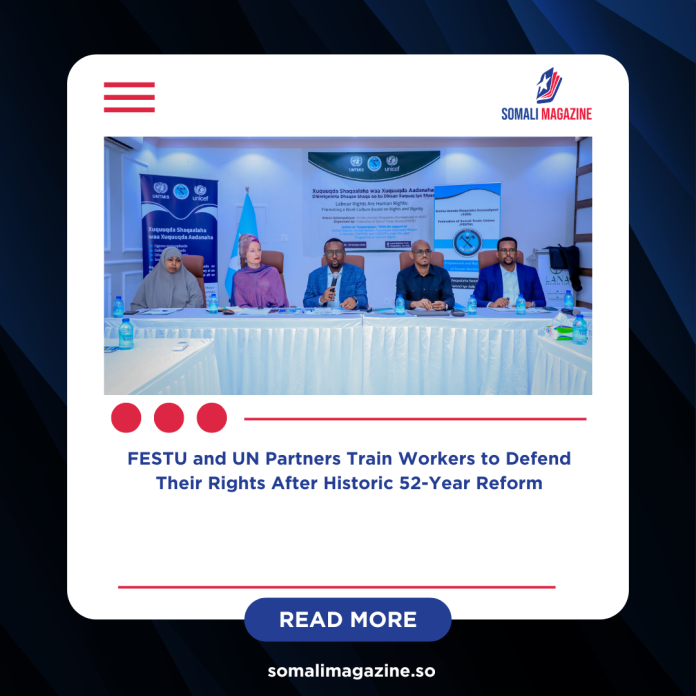
The Federation of Somali Trade Unions (FESTU), with support from the United Nations, has launched a nationwide campaign to educate workers about their rights under Somalia’s newly adopted Labour Code. This new law marks a historic change, coming after 52 years without a full update to the country’s labour legislation. The goal of the campaign is to help workers understand their rights, claim them when necessary, and ensure the law is properly applied in workplaces across the country.
The Labour Code was developed through discussions between the Ministry of Labour and Social Affairs, the Somali Chamber of Commerce and Industry, and FESTU. The process received technical and financial support from the International Labour Organization. After agreement among the parties, the draft law was approved by the Council of Ministers, passed by both houses of Parliament, and signed into law by the President. FESTU and its 12 affiliated unions had pushed for these reforms for more than a decade, describing the new law as a major step forward for workers’ rights and human dignity.
FESTU Secretary General Omar Faruk Osman said Somali workers had long been governed by an outdated legal framework that did not reflect modern workplace realities or match the country’s Constitution and international labour standards. He emphasized that a law only makes a real difference when workers understand it and are ready to defend their rights. According to FESTU, the new Labour Code confirms that dignity at work, protection from exploitation, fair wages, safety, and freedom from harassment are basic human rights.
Between October and December 2025, FESTU rolled out its Labour Rights Education Programme in partnership with the United Nations Transitional Mission in Somalia and UNICEF under a joint human rights initiative. Activities were carried out in Mogadishu and several Federal Member States, including Baidoa, Dhusamareb, and Beledweyne. Workers from different sectors attended workshops to learn about the new legal framework and what it means for them.
Special attention was given to women, young workers, and persons with disabilities. A dedicated training session in Mogadishu focused on empowering women and youth to understand their rights, prevent exploitation, and report harassment. Another session specifically addressed the rights of workers with disabilities, marking the first time this group received tailored training on labour protections, inclusion, and equal treatment.
In total, 218 workers participated in the programme, including 98 women and 120 men. Young workers made up the majority of participants. The initiative also ensured strong representation of persons with disabilities. To keep the momentum going, FESTU selected at least two participants from each training session to serve as peer educators. These trained individuals will continue spreading awareness in workplaces and communities through the union network.
Beyond in-person training, FESTU distributed over 3,200 educational materials printed in both Maxaa Tiri and Maay Somali dialects. These materials clearly explain workers’ rights and responsibilities, as well as the duties of employers and government institutions under the new law. The campaign also included radio and television broadcasts, along with a strong digital outreach strategy that reached millions of people nationwide through social media and traditional media platforms.
A key focus of the campaign was equality and protection from violence. Workshops addressed sexual harassment prevention, reporting channels, and legal safeguards under the Labour Code. Somalia’s adoption of international standards on violence and harassment in the workplace was highlighted, reinforcing protections for women and vulnerable groups. Training sessions for persons with disabilities covered non-discrimination, workplace safety, and access to complaint mechanisms.
FESTU leadership also engaged government officials to advocate for stronger enforcement of the Labour Code, particularly in addressing sexual and gender-based violence at work. Government representatives pledged to strengthen enforcement measures to ensure the law is applied effectively.
As Somalia prepares for its Universal Periodic Review, FESTU says it remains committed to promoting decent work, especially for young people, and reducing inequality in line with global development goals. The union federation praised its UN partners for supporting Somali workers and stressed that open communication and cooperation are essential for building fair and stable working relationships. FESTU maintains that the new Labour Code must move beyond paper and translate into real protection for workers in every workplace across the country.
.