Facebook

Twitter (X)

Instagram

Somali Magazine - People's Magazine
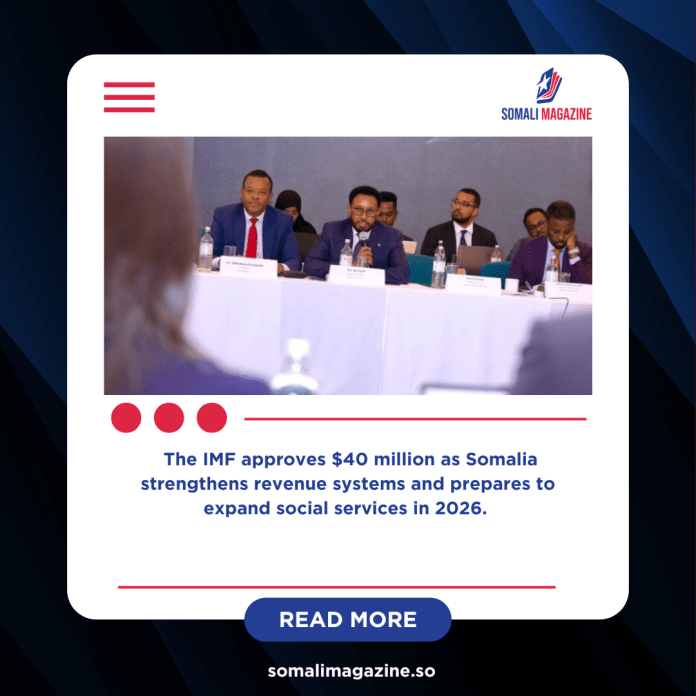
The International Monetary Fund (IMF) has approved an additional $40 million in financing for Somalia after completing the fourth review of the country’s Extended Credit Facility program. Of this amount, $30 million will be released immediately to support the national budget. With this decision, Somalia’s total access under the credit program now rises to about $140 million.
According to the IMF, Somalia has continued to push forward with its reform agenda despite facing major challenges, including a sharp drop in foreign aid, repeated climate-related shocks, and a difficult global economic environment. These pressures have made it harder for the country to maintain steady growth and manage public finances, but Somali authorities plan to increase social spending in 2026 by using more domestic revenue. This shift is meant to help the country become less dependent on external donors and ensure essential services remain protected.
The IMF noted that fiscal performance in 2025 remained strong. Domestic revenue stayed stable, government spending was kept under control, and important structural reforms continued to advance. Somalia’s Cabinet has already approved the 2026 budget, which focuses on raising more domestic revenue, keeping spending disciplined, and protecting funding for key programs—especially those that benefit vulnerable communities.
Among the ongoing reforms highlighted by the IMF are efforts to modernize customs operations, enforce the Income Tax Law more effectively, and strengthen overall revenue administration. These steps are part of a broader plan to help Somalia build a more sustainable and efficient financial system. Improving public financial management and carefully handling debt remain especially important as the country prepares to begin accessing external concessional loans in the future. The IMF also stressed that pay-and-grade reforms and pension changes should be designed in a way that keeps long-term costs manageable.
Somalia’s current credit arrangement with the IMF, approved in December 2023, supports the country’s post-HIPC (Heavily Indebted Poor Countries) reform strategy. It also aligns with Somalia’s long-term national plans, including the National Transformation Plan and the Centennial Vision 2060. With the latest disbursement, total funds released to Somalia under this program now stand at approximately $100 million.
IMF Deputy Managing Director Nigel Clarke praised Somalia’s continued progress, saying that the government has shown strong commitment to implementing reforms even in the face of domestic and international challenges. He noted that the decline in foreign aid, ongoing climate shocks, and wider global uncertainty make it even more important for Somalia to strengthen its policies and increase domestic revenue collection. He welcomed the government’s plan to expand social spending in 2026 using its own resources, calling it an encouraging step toward long-term stability.
Clarke also emphasized the importance of continued support from international development partners to help Somalia stay on track with its reform goals. He pointed to improvements at the Central Bank of Somalia, including better financial regulation, efforts to expand access to financial services, and progress in strengthening the country’s anti-money-laundering and counter-terrorism financing systems. Work is also moving forward on plans to reintroduce the Somali shilling and establish a currency board arrangement to stabilize the national currency.
In addition, Clarke urged Somalia to maintain high levels of transparency and accountability in the petroleum sector under its new legal framework. He said that strong governance, anti-corruption measures, and improved climate resilience will be essential to support economic stability and long-term development.