
Facebook

Twitter (X)

Instagram

Somali Magazine - People's Magazine
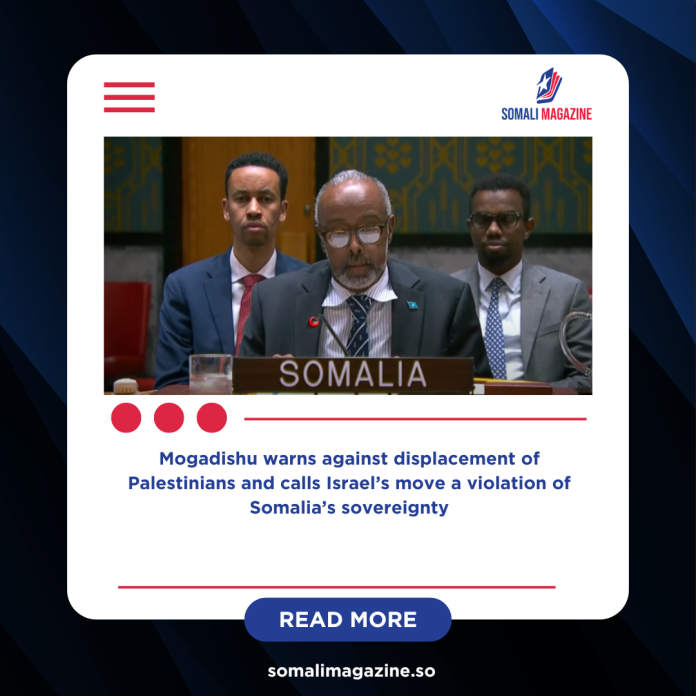
Somalia has urged the international community to stop any effort to forcibly change the status of the Palestinian territories, warning that such actions would violate international law and threaten regional stability. The call was made during a United Nations Security Council meeting, where Somalia’s ambassador to the UN, Abukar Dahir Osman, spoke out against what he described as dangerous political moves that ignore established international rules.
Addressing the council, Osman said that any attempt to unilaterally alter the geographic structure of Palestinian land must be strongly rejected. He stressed that international law is clear on the protection of occupied territories and the rights of their people. According to Somalia’s UN mission, the ambassador warned that imposing political realities by force would only deepen tensions and undermine global peace efforts.
Somalia also strongly criticized Israel’s decision in December to recognize Somaliland as an independent state. Somaliland declared independence from Somalia in 1991, but it has not been recognized by the United Nations or the African Union. For more than three decades, it has operated with its own government and institutions, while Somalia continues to view it as part of its sovereign territory.
Osman described Israel’s recognition of Somaliland as a direct violation of Somalia’s sovereignty, unity, and territorial integrity. He told the council that such actions risk destabilizing the Horn of Africa and interfering in Somalia’s internal affairs. Mogadishu considers the move illegal and believes it sets a troubling precedent for international relations.
In addition, Somalia rejected reports suggesting that Palestinians could be relocated to Somali territory, including Somaliland. Officials described any such proposal as unlawful and unacceptable. Osman warned that forced displacement of Palestinians, whether within their own land or to foreign territories, would amount to ethnic cleansing and breach international law. He cautioned that such actions could inflame tensions not only in the Middle East but also in East Africa.
Somalia’s Defense Minister, Ahmed Moalim Fiqi, recently echoed these concerns in an interview with Al Jazeera. Fiqi said the Somali government had what he called confirmed information about alleged plans to move Palestinians to Somaliland. He described the reported plan as a serious violation of international law and warned that Somalia would oppose any attempt to use its territory in such a manner.
However, authorities in Somaliland have denied the allegations. They stated that their relationship with Israel does not include any agreement to accept displaced Palestinians. Somaliland officials have insisted that claims about relocation plans are unfounded.
Israel’s recognition of Somaliland marked the first time any country formally acknowledged the territory as independent. The move has sparked diplomatic tension between Israel and Somalia, with Mogadishu arguing that the decision undermines Somalia’s internationally recognized borders. Despite running its own political system and holding elections, Somaliland remains unrecognized by major international bodies, including the United Nations and the African Union.
Somalia’s message at the Security Council reflects its broader concern about preserving both international law and its own territorial integrity. By linking the issue of Palestinian displacement with the recognition of Somaliland, Somali officials argue that both matters involve respect for sovereignty and established global norms. They warn that ignoring these principles could open the door to further instability, not only in the Middle East but also across Africa.
In its appeal to the international community, Somalia called for respect for existing borders, protection of civilian populations, and adherence to international legal standards. The government emphasized that political disputes should be resolved through dialogue and lawful processes, rather than unilateral decisions or forced actions that risk escalating conflicts in already fragile regions.