
Facebook

Twitter (X)

Instagram

Somali Magazine - People's Magazine
On a warm afternoon in Mogadishu, 23-year-old Abdirahim Ali Mohamud Shuriye refreshed a website that did not exist a year earlier. After graduating from SIMAD University, he had spent months searching for a job the way many Somali graduates do — scrolling through LinkedIn, Telegram channels, Facebook groups, and WhatsApp messages. Job announcements appeared in bits and pieces. Some were outdated by the time they reached him. Others were shared through personal networks, making it hard to know where or how to apply.
“It was confusing,” he said. “You could hear that an institution was hiring, but you didn’t know where to apply or whether the deadline had passed.”
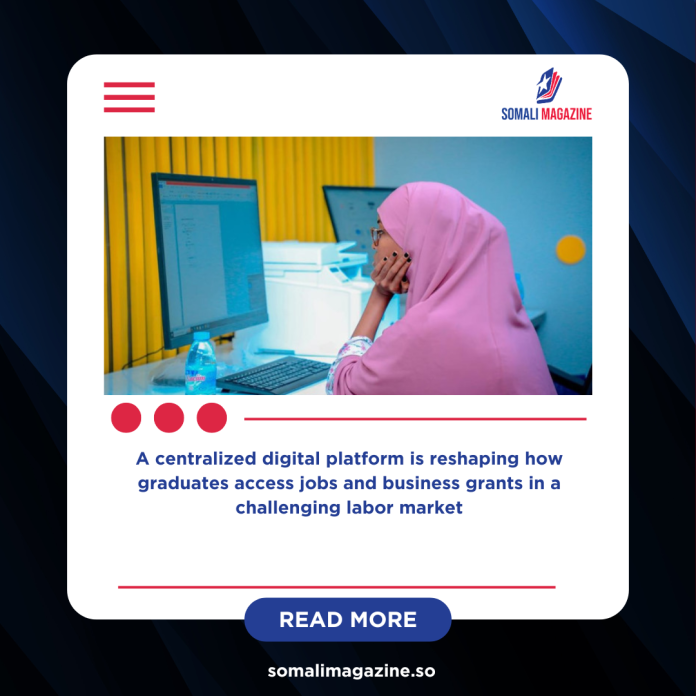
Then he discovered the Somali National Job Portal for Employment Opportunities, a simple online platform that lists vacancies in one place. There were no flashy banners — just a search bar, job listings, and visible counters showing how many job seekers and employers were registered. For Abdirahim, that simplicity made a difference.
He applied through the portal to a national business idea competition advertised by the National Employment Service Center. Weeks later, he learned he had been selected as one of the top ten finalists. After pitching his idea before a panel of private-sector judges and completing five days of training and mentoring, he received a $2,500 grant to help launch his project.
The portal, launched on March 15, 2025, was created to address long-standing problems in Somalia’s job market. For years, each ministry handled recruitment separately. Vacancies were posted on office gates, announced on radio, or briefly uploaded to different websites. Applicants often had to print CVs, photocopy certificates, and submit documents in person. Shortlists were rarely published, and rejected applicants rarely received feedback. International organizations and private companies ran separate hiring systems, and there was no single place where job seekers could see all available opportunities.
This fragmented system made the process difficult, especially for young graduates without strong personal connections. Informal networks often played a bigger role than transparent procedures.
The Somali National Job Portal was designed to bring order to this system. It serves as a single platform where government agencies, private companies, and international organizations can post vacancies, and where applicants can upload their CVs digitally. The platform is part of Somalia’s broader effort to build Digital Public Infrastructure, which aims to create shared, secure digital systems across government institutions instead of isolated platforms.
The portal is managed by the Ministry of Labor and Social Affairs, with technical support from the International Organization for Migration (IOM). It is hosted by the National Data Agency under the Ministry of Posts and Telecommunications. Employers must verify their licenses before posting jobs, and the service is free for both employers and job seekers. Officials say that only CV information is collected, and sensitive personal data is not required.
As of February 12, 2026, nearly 2,000 job seekers were registered on the platform, with 15 active employers and two listed vacancies that day. These numbers highlight a major challenge: while the portal makes job searching more organized and transparent, it does not create jobs on its own. Somalia’s formal job market remains small, and youth unemployment is still high.
Zakariye Abdi Hashi, Director of the Department of Employment and Job Creation at the Ministry, says the portal was created to connect talent with opportunity and to respond to high youth unemployment. The ministry also runs workshops to train young people on how to prepare CVs and improve interview skills, with special sessions for women and persons with disabilities.
Abdirahim’s business idea, called AgriSoko Digital Platform, is still under development. Inspired by conversations with women farmers, the platform aims to connect farmers to markets, provide price information, link buyers and sellers, and improve access to agricultural inputs and finance. He hopes it will support women and youth farmers by reducing post-harvest losses and improving income opportunities.
For him, the biggest impact was not just the $2,500 grant, but the fairness of the process. The opportunity was publicly advertised, applications were submitted online, and judges from outside government made the final decisions. That transparency gave him confidence.
The portal project also involved collaboration with employers’ associations, trade unions, and the Chamber of Commerce. It aligns with Somalia’s National Development Plan, which focuses on job creation and economic recovery, and is supported through international partnerships aimed at strengthening labor systems and reducing poverty.
Beyond job listings, the National Employment Service Center has trained hundreds of young people in communication skills, CV writing, and entrepreneurship. Officials say plans are underway to help create opportunities for tens of thousands of youth in the coming months.
Somalia’s National Job Portal is still new, and challenges remain. But for graduates like Abdirahim, it represents a shift toward a more open and organized system — one where opportunity is posted publicly and accessed digitally, rather than hidden behind closed doors.