
Facebook

Twitter (X)

Instagram

Somali Magazine - People's Magazine
Two members of Somaliland’s House of Representatives have accused the government of intimidation and repression in the Awdal region following the arrest of a young man who reportedly raised a Palestinian flag during public celebrations linked to Israel’s recognition of Somaliland. The lawmakers say the arrest highlights selective enforcement of the law and deepens long-standing political grievances in the region.
The incident reportedly took place in Borama, the main city in Awdal, where residents gathered after Israel announced it had recognized Somaliland. According to the lawmakers, while some people openly waved Israeli flags during the celebrations, a young man who raised a Palestinian flag was arrested by security forces. This, they argue, shows discrimination and unequal treatment by the authorities.
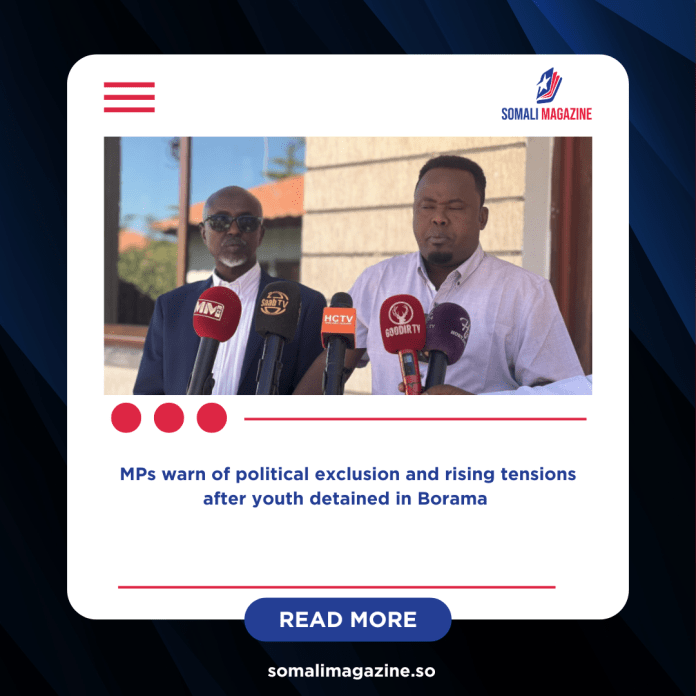
Speaking at a press conference in Hargeisa, MP Mohamed Abiib and MP Maydhane strongly criticized the arrest, saying it had no legal basis. They stressed that Somaliland’s constitution clearly protects freedom of expression and does not prohibit the display of the Palestinian flag or any other political symbol. MP Maydhane said the arrest violated constitutional rights and sent a worrying message to citizens about the limits of free speech.
The lawmakers described Borama as a city known for peace and stability and warned that such actions by the government risk creating unnecessary tension. They accused the authorities of using arrests as a political tool, arguing that this approach could undermine security in a region that has largely remained calm over the years. According to them, instead of maintaining stability, the government’s actions could provoke anger and mistrust among the local population.
Abiib and Maydhane also linked the arrest to broader concerns about political exclusion in Awdal. They said the region has long complained about marginalization and lack of fair representation within Somaliland’s political system. In their view, the recent arrests are part of a wider pattern of ignoring or silencing voices from Awdal, especially when they express opinions that differ from those of the central government in Hargeisa.
The lawmakers warned that continued exclusion could have serious consequences for Somaliland’s unity. MP Maydhane said the people of Awdal are increasingly frustrated and feel their sacrifices during Somaliland’s struggle for self-rule have not been properly acknowledged. He argued that political recognition and fair power-sharing are necessary to maintain trust and cohesion within the region.
“There are only two choices,” Maydhane said, warning that either Awdal receives its fair share of government representation or its people may be forced to rethink their relationship with Somaliland. He stressed that such discussions are not about creating conflict but about addressing long-standing grievances before they escalate further.
In recent days, reports have emerged that several individuals from Awdal, including religious scholars and intellectuals, have been detained in Hargeisa after publicly criticizing Somaliland’s relationship with Israel. Sources familiar with the arrests say those targeted were individuals who expressed support for Palestine or questioned the political implications of the recognition deal.
Residents and activists claim the arrests have been one-sided. They say people displaying Palestinian symbols have been detained, while those openly waving Israeli flags have not faced similar treatment. This, they argue, reinforces perceptions of bias and fuels resentment among communities that already feel sidelined.
So far, Somaliland authorities have not publicly responded to the specific accusations raised by the lawmakers. The lack of an official explanation has left many residents confused and concerned about the direction the government is taking, particularly regarding civil liberties and political inclusion.
Israel’s decision to recognize Somaliland has triggered strong reactions across Somalia and the wider region. Critics argue the move goes against international law and could increase instability in the Horn of Africa. Within Somaliland itself, the decision has exposed internal divisions, especially in regions like Awdal, where questions of governance, representation, and respect for differing political views remain unresolved.