
Facebook

Twitter (X)

Instagram

Somali Magazine - People's Magazine
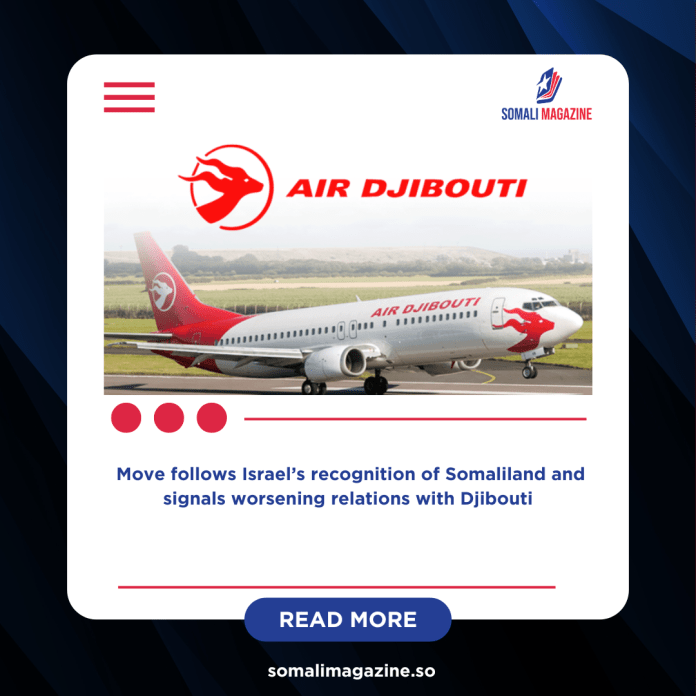
Somaliland authorities have ordered Djibouti’s national airline, Air Djibouti, to suspend all flights to Somaliland starting January 7, a move that reflects worsening diplomatic relations between the two neighboring territories. The decision comes amid growing regional tension following Israel’s announcement that it has recognized Somaliland as an independent state.
According to BBC Somali, the Somaliland government formally informed Air Djibouti of the directive and set a clear deadline for the suspension to take effect. The airline has been operating several flights each week between Djibouti and Somaliland, providing one of the most important air links connecting Hargeisa with Djibouti City. These flights have been widely used by business travelers, families, government officials, and members of the Somali diaspora moving between the two sides.
As of now, neither Somaliland authorities nor Air Djibouti have publicly commented on the reported decision. However, BBC Somali indicated that the airline is expected to issue a statement clarifying its position and how it plans to respond to the order. Until then, passengers remain uncertain about the status of their travel plans, with many expressing concern about disruptions to movement and trade.
The reported suspension is closely tied to a broader political dispute that erupted after Israel announced it had recognized Somaliland as a sovereign state. While Somaliland welcomed the move as a historic breakthrough in its long-standing quest for international recognition, the decision has drawn strong opposition from Somalia and several countries in the region. Djibouti has been among the most vocal critics, reiterating its firm support for Somalia’s federal government and its commitment to preserving Somalia’s territorial unity.
Tensions between Djibouti and Somaliland have escalated in recent weeks. Djibouti recently announced the closure of Somaliland’s diplomatic liaison office in Djibouti City, a move widely interpreted as a clear political signal rejecting Israel’s recognition and aligning Djibouti more closely with Mogadishu. The closure marked a significant setback for Somaliland’s diplomatic engagement with one of its closest neighbors.
Somaliland declared independence from Somalia in 1991 following the collapse of Somalia’s central government. Since then, it has operated as a self-governing entity with its own institutions, elections, and security structures. Despite more than three decades of relative stability, Somaliland has not received formal recognition from the international community. Israel’s announcement therefore sparked sharp debate, with critics arguing that such recognition undermines international law and could increase instability in the already fragile Horn of Africa region.
For Somaliland, the possible suspension of Air Djibouti flights represents more than just a diplomatic dispute. Djibouti has long served as a critical economic and transit hub for Somaliland, particularly for trade, aviation, and regional connectivity. Any prolonged disruption to air travel could affect commerce, medical travel, education, and family connections, especially for people who rely on frequent movement between the two territories.
If confirmed, the flight suspension would mark a further deterioration in relations between Somaliland and Djibouti, raising concerns about the broader impact on regional cooperation. Observers warn that escalating diplomatic actions on both sides could deepen divisions and reduce opportunities for dialogue at a time when the Horn of Africa is already facing significant political and security challenges.
As the situation unfolds, many in Somaliland and Djibouti are watching closely to see whether cooler heads will prevail or whether the dispute will continue to affect everyday life for ordinary citizens who depend on cross-border travel and cooperation.