
Facebook

Twitter (X)

Instagram

Somali Magazine - People's Magazine
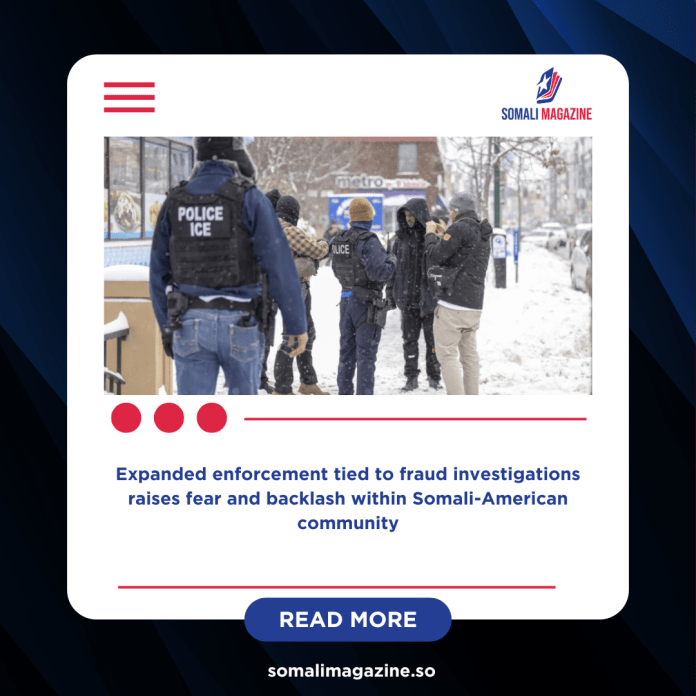
The Trump administration is preparing to send about 2,000 federal immigration agents to Minnesota, marking a major expansion of enforcement operations in the state. According to two law enforcement officials familiar with the plan, the deployment will mainly focus on the Twin Cities area and involve agents from U.S. Immigration and Customs Enforcement as well as the U.S. Border Patrol. A senior Customs and Border Protection commander, Gregory Bovino, who has overseen similar operations in other major cities, is also expected to be involved.
Federal officials say agents are already active in Minnesota, but this new move represents a significant increase in scale and intensity. The deployment comes as the administration renews its focus on alleged welfare, child nutrition, and child care fraud, particularly cases linked to nonprofit organizations associated with members of the Somali community. The issue has been repeatedly highlighted by President Donald Trump and senior officials in recent weeks, adding to political pressure and public scrutiny in the state.
The Department of Homeland Security confirmed that federal law enforcement activity has increased but declined to provide details about the operation. Tricia McLaughlin, the department’s assistant secretary for public affairs, said authorities do not publicly discuss the size or location of deployments, citing officer safety. She added that DHS has increased enforcement efforts nationwide and claimed more than 1,000 arrests have been made across the country involving people accused of serious crimes.
The renewed attention on Minnesota is closely tied to ongoing fraud investigations that date back several years. One of the most prominent cases is the Feeding Our Future scandal, in which federal prosecutors charged dozens of people in 2022. The nonprofit at the center of the case was accused of falsely claiming to provide meals to children during the COVID-19 pandemic and diverting tens of millions of dollars for personal use. Court records show that at least 37 defendants have pleaded guilty so far. Public documents do not clearly state how many of those charged are Somali, but the case has been widely used in political rhetoric.
Tensions escalated again late last year after a conservative YouTuber, Nick Shirley, released a video accusing Somali-run child care centers in Minneapolis of widespread fraud. The video showed him attempting to enter several facilities while claiming he wanted to enroll a child. After the video spread widely online and was shared by prominent political figures, state investigators inspected the centers mentioned and later said they were operating within the rules. Child care providers featured in the video strongly denied the accusations, calling them misleading and harmful.
Despite those findings, the controversy has had real consequences. Some federal child care funds allocated to Minnesota remain frozen, and state officials are under pressure to submit additional documentation explaining how the money was distributed. The issue has also taken a political toll. Governor Tim Walz recently announced he will not seek reelection, saying organized political efforts had turned the situation into a broader campaign of pressure and misinformation.
The increased federal presence has caused fear and uncertainty within Minnesota’s Somali community, even though most Somali-Americans in the state are U.S. citizens. Many residents say they have begun carrying passports or other identification documents out of concern they could be stopped or questioned. In early December, a 20-year-old U.S. citizen of Somali descent was briefly detained by a masked federal agent before being released, an incident that drew public criticism.
Other encounters sparked protests and concern from local leaders. Minneapolis Police Chief Brian O’Hara criticized federal agents after video footage showed a woman pinned to the ground during an enforcement operation, an image that revived painful memories in a city still deeply affected by the killing of George Floyd in 2020.
The Twin Cities are home to the largest Somali-American population in the United States. Census data show that more than half of Somalis in Minnesota were born in the country, and most immigrants from Somalia have become naturalized citizens. Community leaders say isolated cases of wrongdoing are being unfairly used to cast suspicion on an entire community.
Jaylani Hussein, head of the Minnesota chapter of the Council on American-Islamic Relations, said the pattern is familiar and damaging. He warned that broad accusations create fear, hurt businesses, and weaken trust in public institutions. He emphasized that Somali-Americans in Minnesota are workers, students, small business owners, and taxpayers who contribute daily to the state’s economy and social life.