Facebook

Twitter (X)

Instagram

Somali Magazine - People's Magazine
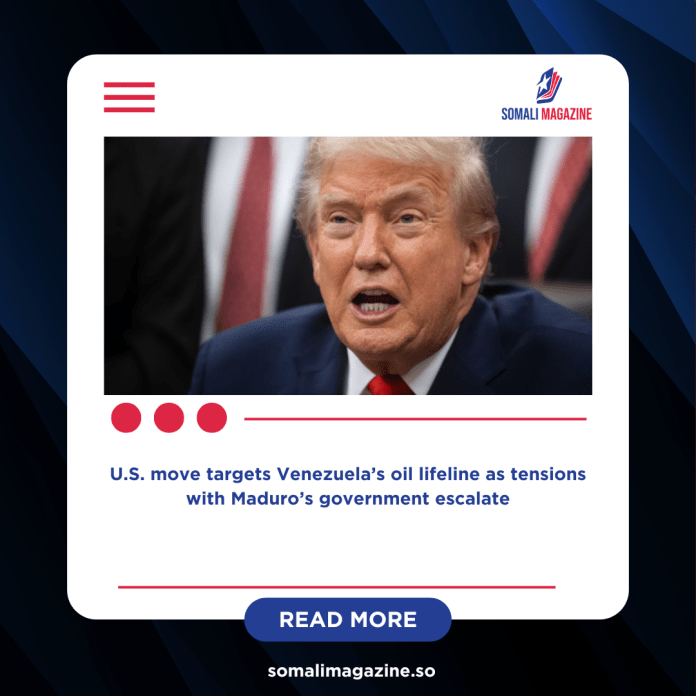
President Donald Trump on Tuesday announced plans to impose a blockade on all oil tankers linked to U.S. sanctions entering or leaving Venezuela, sharply escalating pressure on President Nicolás Maduro’s government. The move signals a tougher U.S. stance aimed at cutting off one of Venezuela’s main economic lifelines and increasing leverage over an already struggling economy heavily dependent on oil exports.
The announcement came days after U.S. forces seized an oil tanker near Venezuela’s coast, an unusual action that followed a noticeable buildup of American military assets in the Caribbean region. In a message posted on social media, Trump accused Venezuela of using oil revenues to fund drug trafficking and other criminal activities. He said the United States would continue expanding its military presence until Venezuela hands over oil, land, and other assets he claimed were taken from the U.S., though no legal basis for such claims was explained.
Trump described Venezuela as being surrounded by what he called the largest naval force ever assembled in South America, warning that pressure would only increase. Pentagon officials declined to comment directly on the statement, referring questions to the White House.
Venezuela’s government quickly responded, condemning the proposed blockade as a violation of international law and the principle of free navigation. In an official statement, authorities accused Trump of making reckless threats and acting as if Venezuela’s natural resources belonged to the United States. The government said it would raise the issue at the United Nations, arguing that the blockade amounts to an attempt to seize the country’s wealth through force.
The military buildup around Venezuela has already included a series of U.S. strikes on boats in international waters in the Caribbean and eastern Pacific. According to available reports, at least 95 people have been killed in 25 known incidents. While the Trump administration has said these actions are part of efforts to stop drugs from reaching the United States, the campaign has drawn criticism from lawmakers in both political parties, with concerns raised about legality and civilian harm. Trump has also hinted that future operations could extend beyond the sea and onto land.
Administration officials have defended the operations as effective, saying they have disrupted drug trafficking routes. However, comments from Trump’s chief of staff, Susie Wiles, suggested a broader political goal. In an interview published Tuesday, she indicated that the pressure campaign is also intended to force Maduro from power, reinforcing the idea that the blockade is part of a wider effort to destabilize his government.
Oil is central to Venezuela’s economy. The country holds the world’s largest proven oil reserves and currently produces around one million barrels per day. Since U.S. sanctions were imposed in 2017, Venezuela’s state-owned oil company, PDVSA, has been largely shut out of global markets. To keep exports flowing, the government has relied on a network of unregistered tankers to move crude oil quietly into international supply chains, mostly selling at discounted prices.
Most of Venezuela’s exported oil goes to China, while smaller amounts reach the United States through limited licenses involving companies such as Chevron, and some supplies are sent to Cuba. Experts say roughly 850,000 barrels of Venezuela’s daily production are exported, making any disruption to shipping a serious threat to government revenue.
Details on how the blockade would be enforced remain unclear. Still, the U.S. Navy has significant resources in the region, including warships, aircraft, and surveillance planes capable of tracking marine traffic. These assets give the U.S. the ability to monitor and potentially intercept vessels traveling to and from Venezuela.
Trump also claimed that Venezuela’s government has been labeled a foreign terrorist organization, though no clear confirmation or legal explanation was provided. Traditionally, such designations apply to non-state groups, not sovereign governments, and Venezuela is not officially listed by the U.S. as a state sponsor of terrorism.
As tensions rise, the proposed blockade raises serious questions about international law, regional stability, and the humanitarian impact on Venezuelans already facing economic hardship.