
Facebook

Twitter (X)

Instagram

Somali Magazine - People's Magazine
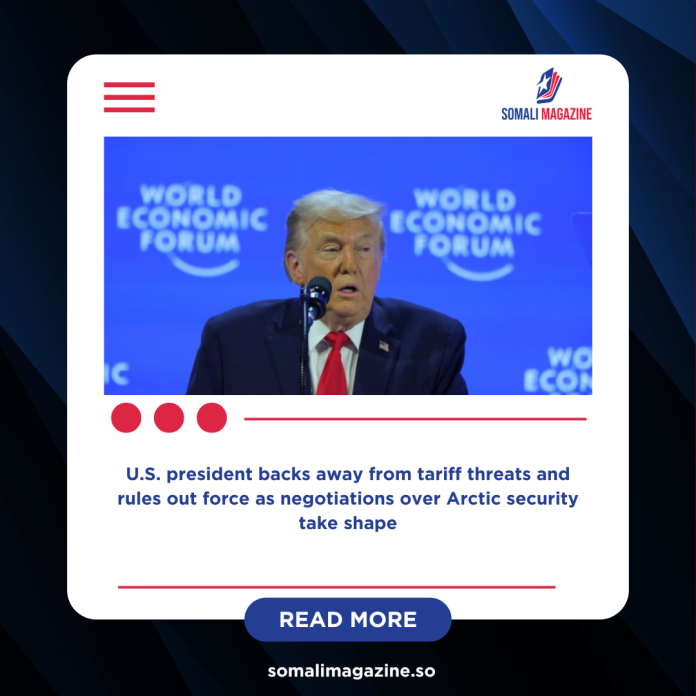
U.S. President Donald Trump on Wednesday appeared to ease tensions with key European allies after stepping back from earlier threats to impose tariffs and use them as leverage in a dispute involving Greenland, a semi-autonomous Danish territory. Speaking during a visit to Davos, Switzerland, Trump ruled out the use of military force and signaled that negotiations could lead to a long-term agreement focused on security and economic interests in the Arctic.
For weeks, Trump’s remarks about Greenland had unsettled NATO allies and raised fears of a serious breakdown in transatlantic relations. Over the weekend, he had warned that the United States could impose escalating tariffs on exports from several European countries if his concerns were not addressed. Those comments added to worries about a possible global trade conflict and further strained ties between Washington and European capitals.
However, after meeting NATO Secretary General Mark Rutte on the sidelines of the World Economic Forum, Trump struck a more conciliatory tone. He suggested that Western allies could reach a deal that protects the Arctic region from growing Russian and Chinese influence while also meeting U.S. interests, including access to critical minerals and enhanced missile defense capabilities. Trump described the potential agreement as a lasting arrangement that would benefit all parties involved, particularly in terms of security.
Rutte later confirmed that the question of Greenland’s ownership did not come up in his discussions with Trump. Instead, he said the focus was on how NATO allies could better safeguard the Arctic, a region undergoing rapid change and attracting increased attention from global powers. European diplomats privately welcomed Trump’s softer approach, saying it reduced the immediate risk of an open clash, even though major disagreements remain unresolved.
It is still unclear what form any future agreement might take. Greenland’s leaders and residents have repeatedly said the territory is not for sale, and Denmark has emphasized that Greenland’s status is a matter of sovereignty and self-determination. A NATO spokesperson said discussions involving Denmark, Greenland, and the United States would aim to ensure that Russia and China do not gain economic or military influence on the island. No timeline or location for these talks has been announced.
Trump said he had asked Vice President JD Vance, Secretary of State Marco Rubio, and special envoy Steve Witkoff to lead further discussions. Meanwhile, Russia sought to downplay the issue, with President Vladimir Putin reportedly saying that developments in Greenland were of no direct concern to Moscow.
In a post on his Truth Social platform, Trump said the United States and NATO had agreed on a basic framework for future cooperation on Greenland and the wider Arctic region. Based on that understanding, he said, the tariffs he had threatened to impose starting February 1 would not go ahead. This marked another instance in which Trump reversed or softened a major policy threat ahead of a self-imposed deadline during his second term.
Denmark responded by urging that sensitive issues be handled through quiet diplomacy rather than public statements. Foreign Minister Lars Løkke Rasmussen said the most important outcome would be respect for Denmark’s territorial integrity and for the Greenlandic people’s right to decide their own future. Greenland’s government did not publicly comment.
Earlier in the day, Trump acknowledged that financial markets had reacted negatively to his earlier rhetoric and again ruled out the use of force while addressing business and political leaders in Davos. His shift in tone helped calm investors, with U.S. stock markets rebounding after recent losses linked to fears over trade and geopolitical instability.
Trump’s comments on Greenland dominated his high-profile appearance at the forum, where he also criticized European countries on issues ranging from energy and immigration to defense spending. While insisting he wanted strong allies, his remarks drew mixed reactions from the audience. Despite the international focus, Trump spent little time addressing domestic economic concerns, such as rising living costs, which remain a key challenge for his administration.
Analysts say Trump’s interest in Greenland is partly driven by strategic calculations and partly by a desire to secure a historic legacy through territorial expansion. As his Davos trip continued, he was expected to meet other world leaders to promote his broader foreign policy initiatives, even as questions remained about how his Arctic ambitions would ultimately be resolved.