
Facebook

Twitter (X)

Instagram

Somali Magazine - People's Magazine
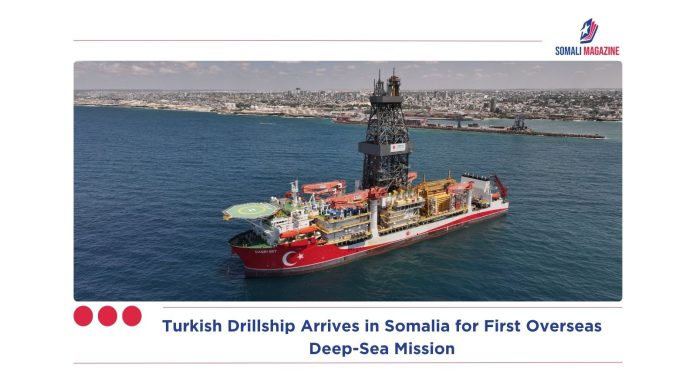
The arrival of a Turkish drillship Somalia marks a historic moment in the country’s push to unlock its offshore energy potential, as the vessel begins its first overseas deep-sea mission along the nation’s coastline. The deployment signals a new phase in Somalia’s natural resource exploration and highlights deepening ties with international partners.
Operated under a bilateral agreement between Somalia and Turkey, the drillship is expected to conduct seismic surveys and exploratory drilling in Somali waters. Officials say the mission aims to assess hydrocarbon reserves that could significantly reshape the country’s economic outlook if commercially viable deposits are confirmed.
For years, Somalia offshore exploration has remained largely untapped, despite studies suggesting the presence of substantial oil and gas reserves beneath its extensive coastline. Decades of instability delayed progress in the sector, but recent reforms and improved security have created conditions for renewed investor interest. The Turkish drillship Somalia initiative represents one of the most concrete steps taken so far toward turning that potential into measurable results.
Government representatives have described the deep-sea mission Somalia as a milestone in national development efforts, linking it to broader ambitions of economic diversification and energy independence. Revenues from the Somalia energy sector could play a transformative role in funding infrastructure, public services, and job creation, although officials stress that exploration remains in its early stages.
Turkey’s involvement reflects an expanding Turkey Somalia energy partnership that has grown steadily in recent years, spanning infrastructure, security cooperation, and humanitarian support. Analysts note that Ankara’s technical expertise and investment capacity position it as a key player in Somalia’s emerging extractive industries. The current mission is also seen as part of Turkey’s broader strategy to extend its energy footprint beyond domestic and regional boundaries.
At the same time, experts caution that offshore exploration carries both opportunities and challenges. Environmental considerations, regulatory frameworks, and transparent governance will be critical in ensuring that any future resource development benefits the Somali population. International best practices, they argue, must guide the process from exploration through to potential production.
The arrival of the drillship has also drawn attention from global energy markets, where frontier exploration regions are increasingly seen as the next frontier for oil and gas discoveries. Somalia’s long coastline along the Indian Ocean positions it strategically within this landscape, though much will depend on the findings of the current mission.
As the Turkish drillship Somalia begins operations, expectations are high but measured. The mission represents not just a technical undertaking, but a symbolic خطوة forward in Somalia’s ongoing journey toward economic recovery and self-reliance. Its outcomes could influence the trajectory of the country’s energy ambitions for years to come.