
Facebook

Twitter (X)

Instagram

Somali Magazine - People's Magazine
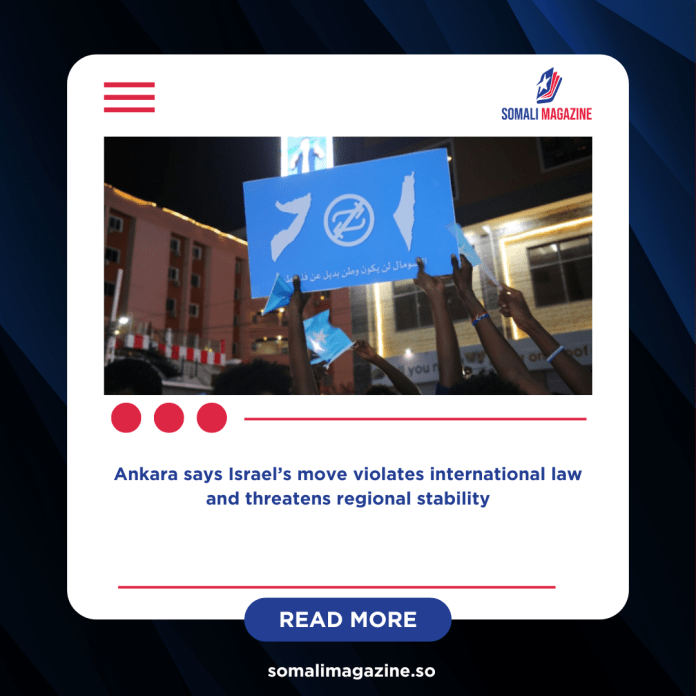
Türkiye has once again voiced strong support for Somalia’s sovereignty and territorial integrity, firmly rejecting Israel’s decision to recognize Somaliland as an independent state. The position was reiterated on Saturday during a high-level diplomatic meeting of the Organization of Islamic Cooperation (OIC), underscoring growing international opposition to Israel’s move.
The statement was delivered by Turkish Deputy Foreign Minister Ambassador Musa Kulaklıkaya, who chaired the 22nd Extraordinary Session of the OIC Council of Foreign Ministers. The emergency meeting, held in Saudi Arabia, was convened specifically to discuss Israel’s recent announcement recognizing Somaliland as a sovereign country. Speaking on behalf of Türkiye, Kulaklıkaya made it clear that Ankara considers the decision a violation of international law and a direct challenge to Somalia’s internationally recognized borders.
According to a statement released by the Turkish Foreign Ministry on its official NSosyal platform, Kulaklıkaya emphasized Türkiye’s long-standing and consistent support for Somalia’s unity. He stressed that any attempt to alter Somalia’s territorial integrity through unilateral recognition sets a dangerous precedent, particularly in a region as politically sensitive as the Horn of Africa. Türkiye, he said, remains committed to upholding international legal principles that respect the sovereignty of nations and the inviolability of their borders.
In his remarks, the Turkish deputy foreign minister also reaffirmed Türkiye’s broader foreign policy stance on regional and global issues, including its continued backing of international efforts to protect the rights of the Palestinian people. He reiterated Ankara’s call for lasting peace and stability in the Middle East, noting that respect for international law must remain central to resolving conflicts and preventing further instability.
Israel announced on December 26 that it had formally recognized Somaliland as an independent and sovereign state, making it the first and, so far, only country to do so. The announcement immediately sparked strong backlash from the Somali federal government, neighboring countries, and several international and regional organizations. Critics argue that the move undermines Somalia’s sovereignty, violates international norms, and risks inflaming tensions in an already fragile region.
Somaliland declared independence from Somalia in 1991 after the collapse of the central government in Mogadishu. Since then, it has functioned as a self-governing entity with its own political institutions, security forces, and electoral processes. Despite maintaining relative stability compared to other parts of Somalia, Somaliland has never received formal international recognition as a sovereign state. The international community has consistently maintained that Somaliland remains part of Somalia under international law.
Türkiye’s stance closely mirrors that of major regional and multilateral bodies, including the African Union, the Arab League, and the Organization of Islamic Cooperation. All three organizations have repeatedly affirmed their support for Somalia’s unity and have rejected any unilateral actions that seek to recognize Somaliland as an independent state without the consent of the Somali federal government.
The extraordinary OIC meeting highlights increasing diplomatic pressure on Israel as Somalia works to rally international support against the recognition. Somali officials have described Israel’s decision as a serious threat to national sovereignty and a move that could destabilize the wider Horn of Africa. They warn that such actions may encourage separatist movements elsewhere on the continent, potentially undermining decades of efforts to preserve post-colonial borders and regional stability.
As the debate continues, Türkiye has positioned itself as a key ally of Somalia on the international stage, reinforcing its message that respect for sovereignty, territorial integrity, and international law remains essential for peace and security, both in Africa and beyond.