
Facebook

Twitter (X)

Instagram

Somali Magazine - People's Magazine
The United States and Israel carried out major airstrikes on Iran on Saturday, marking a sharp escalation in tensions in the Middle East. U.S. President Donald Trump announced that “major combat operations” were underway and directly addressed the Iranian people, urging them to rise up against their government. He told them this could be their “only chance for generations” to take control of their country from the Islamic leadership that has ruled since the 1979 revolution.
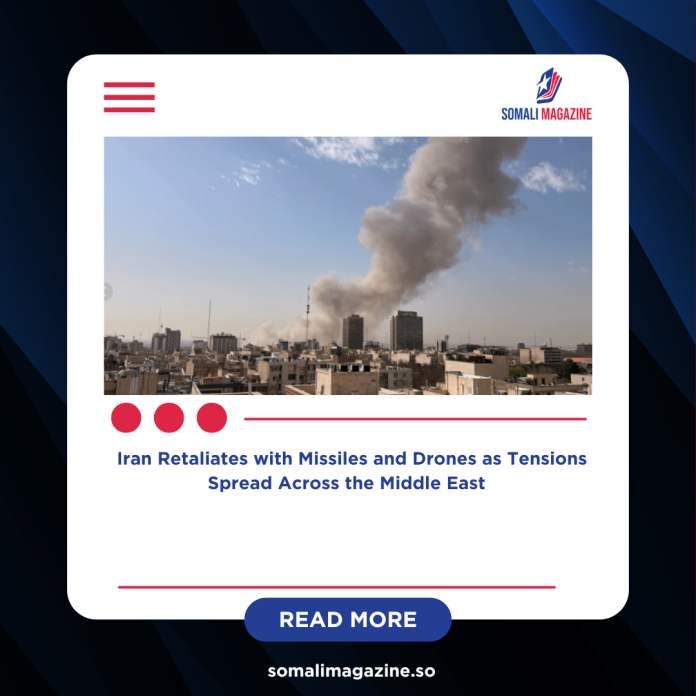
Some of the first strikes appeared to target areas near the offices of Iran’s Supreme Leader. Iranian state media reported explosions across the country, with smoke seen rising over parts of the capital, Tehran. Roads around key government buildings were closed, and residents reported hearing multiple blasts.
Israeli Prime Minister Benjamin Netanyahu supported Trump’s message, saying the joint operation aimed to create conditions that would allow Iranians to determine their own future. Both leaders framed the attack as not only a military operation but also a political turning point for Iran.
The strikes came after weeks of rising tensions. The United States had moved warships into the region, and Trump had pushed for a new agreement to limit Iran’s nuclear program. Iran has faced internal pressure in recent years, including widespread protests and economic struggles. The latest military action marked the second time in less than a year that the Trump administration has used force against Iran.
Iran quickly retaliated. It launched missiles and drones toward Israel, triggering air raid sirens across the country as Israeli forces worked to intercept the incoming threats. Iran also targeted U.S. military sites in Bahrain, Kuwait, and Qatar. In the United Arab Emirates, shrapnel from an Iranian missile reportedly killed one person. Several countries, including the UAE and Iraq, temporarily closed their airspace due to safety concerns.
Iran’s Foreign Ministry issued a strong statement promising to defend the country. It said Iran would not hesitate to respond to what it described as a military assault. The government called on its people to defend the homeland.
Tragically, five students were killed when an airstrike hit a girls’ school in the southern city of Minab, according to Iran’s state news agency. The area is known to host a base for Iran’s Revolutionary Guard. These were the first confirmed deaths reported inside Iran since the new round of fighting began.
Trump defended the military action by accusing Iran of continuing to develop its nuclear program and working on missiles that could eventually reach the United States. He acknowledged that war could lead to American casualties, saying such losses “often happen in war.” His remarks stood out because he had previously campaigned on avoiding long-term foreign conflicts.
In explaining the broader goals of the operation, Trump said the U.S. intended to weaken Iran’s navy and eliminate regional groups supported by Tehran. He also urged members of Iran’s Revolutionary Guard to lay down their weapons, promising immunity if they complied but warning of severe consequences if they did not.
Iran maintains that it has the right to enrich uranium and denies plans to build long-range missiles capable of reaching the U.S. Although it says it has limited its missile range, Western officials have long expressed concern about its weapons and space programs. Satellite images recently showed new activity at nuclear-related sites that had been targeted in earlier fighting, raising questions about Iran’s intentions.
Across the region, tensions spread quickly. Sirens sounded in several countries hosting U.S. forces. The U.S. advised its citizens in parts of the Middle East to shelter in place. Meanwhile, Iran-backed groups in Yemen signaled they could resume attacks on Red Sea shipping routes and Israel.
The situation remains highly volatile, with fears growing that the conflict could widen further and draw in more countries.