
Facebook

Twitter (X)

Instagram

Somali Magazine - People's Magazine
Uganda has announced plans to withdraw its troops from Somalia, signaling the end of a nearly 20-year military presence that has been central to international peacekeeping efforts in the country. The decision, revealed through a brief public statement, raises fresh questions about Somalia’s security future and the ongoing fight against the militant group Al-Shabab.
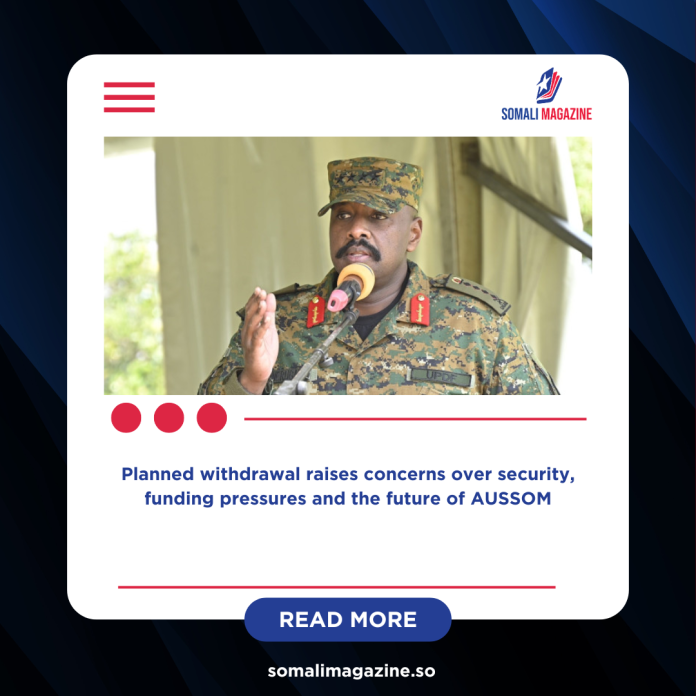
The announcement was made on Sunday by Uganda’s Commander-in-Chief of the Armed Forces, Gen. Muhoozi Kainerugaba, who said the mission had effectively come to an end and that preparations were underway for a full pullout. He stated that after 19 years in Somalia, Uganda intended to withdraw all its troops very soon, though he did not provide a specific timeline or further details on how the process would unfold.
Uganda currently provides the largest number of soldiers to the African Union Support and Stabilization Mission in Somalia, known as AUSSOM. Estimates suggest between 5,000 and 6,000 Ugandan troops are deployed across the country. Over the years, these forces have been responsible for guarding some of Somalia’s most critical locations, including Aden Adde International Airport, the Port of Mogadishu, and other strategic government installations in the capital.
Uganda’s role in Somalia dates back to 2007, when it became the first country to send troops under the African Union peacekeeping mission. At a time when Somalia was deeply unstable and government institutions were extremely weak, Uganda’s early deployment helped lay the groundwork for broader international involvement. Since then, Ugandan forces have remained at the core of security operations, often operating on the front lines against Al-Shabab.
Beyond providing troops, Uganda has also played a leadership role within the mission. Ugandan officers have held senior command positions and have been involved in planning and coordinating major operations. Their presence has supported efforts to push Al-Shabab out of key urban areas and has contributed to the gradual rebuilding of Somali security forces, even though the militant group remains a serious threat.
So far, there has been no official response from the Somali government or the African Union regarding the announcement. It is also unclear how Uganda’s withdrawal would be managed, whether it would happen in phases, or if other troop-contributing countries would step in to fill the gap. Security experts warn that a sudden or poorly coordinated exit could leave vulnerable areas exposed, especially at a time when Somalia is still struggling to stabilize.
The timing of Uganda’s announcement comes as AUSSOM faces serious financial challenges. The mission began its current mandate on January 1, 2025, but it has been operating under significant funding pressure. Major donors have reduced or suspended their support, creating gaps that have affected day-to-day operations and delayed payments to troop-contributing countries.
The European Union, which has long been a key financial backer of the mission, has scaled back its contributions. At the same time, the United States has suspended its funding, citing concerns about how costs are shared among international partners. These decisions have left the African Union struggling to cover operational expenses and clear outstanding arrears owed to countries like Uganda.
While the financial strain has not been officially linked to Uganda’s decision, it has added to uncertainty around the future of the mission. Uganda’s long-standing involvement has often been described as a pillar of stability for AUSSOM, and its planned withdrawal is likely to intensify discussions about how the mission will continue and who will shoulder the burden going forward.
As Somalia continues its slow path toward lasting peace, Uganda’s exit marks the end of a major chapter in the country’s security story. How this transition is handled will be crucial in determining whether recent gains are sustained or whether new security gaps emerge in the months ahead.