
Facebook

Twitter (X)

Instagram

Somali Magazine - People's Magazine
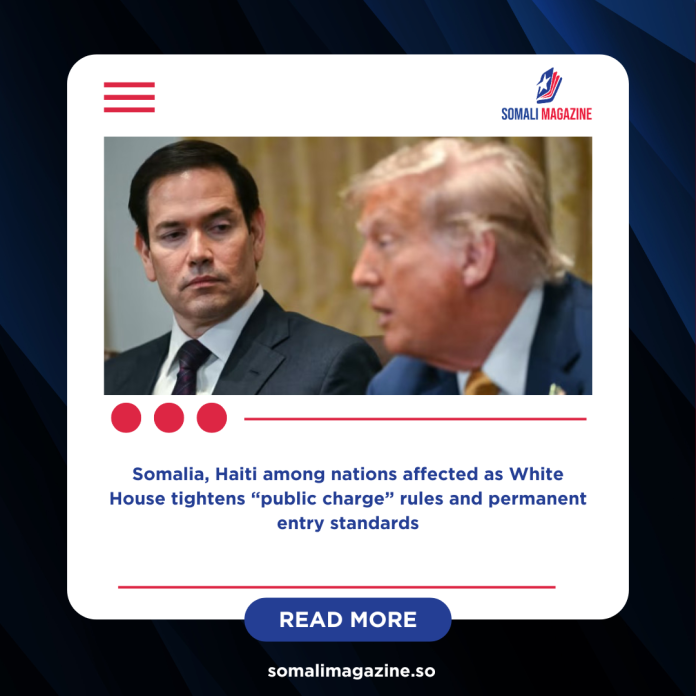
The White House has ordered a temporary pause on the issuance of U.S. immigration visas for citizens of dozens of countries, including Somalia and Haiti, as the Trump administration moves to tighten immigration rules and expand how the government decides who can enter the country permanently. The decision, announced on January 14, is part of a broader effort to revive and strengthen so-called “public charge” rules, which focus on whether immigrants are likely to rely on government assistance.
The State Department confirmed the pause through social media but did not release an official list of affected countries. Instead, officials referred journalists to media reports, which said nationals of about 75 countries across Africa, the Middle East, the Caribbean, and parts of Europe and Asia could be impacted. According to those reports, the list includes Somalia, Haiti, Iran, Cuba, Afghanistan, Ethiopia, Nigeria, Sudan, and South Sudan, among many others.
In a brief statement, the State Department said the move is meant to prevent the misuse of public benefits. Officials argued that the U.S. immigration system should ensure that new immigrants can support themselves and do not place a financial burden on American taxpayers. The department said the pause would remain in place until the government is confident that new applicants will not rely heavily on public assistance.
The restriction mainly affects people applying for permanent immigration visas. It does not appear to apply to tourists, short-term visitors, or athletes traveling on temporary visas. Administration officials also said the pause will not affect athletes and teams participating in the 2026 FIFA World Cup, which will be hosted jointly by the United States, Mexico, and Canada.
The decision comes at a time of increased political attention on immigrant communities, particularly Somali-Americans in Minnesota. The Twin Cities area is home to the largest Somali population in the United States, and recent political debates have focused on fraud cases linked to public assistance programs in the state. President Donald Trump and his allies have pointed to these cases as examples of abuse of government benefits, even though federal prosecutors first brought the cases during the previous administration.
In recent days, the issue has gained further attention after Elon Musk, a high-profile Trump supporter, shared a post highlighting claims that Somali immigrant households receive public assistance at higher rates than native-born Americans. Critics argue that such claims oversimplify complex social and economic realities and unfairly target entire communities.
The visa pause is closely tied to the administration’s plan to expand enforcement of public charge rules. These rules have existed in U.S. immigration law since 1882 and are meant to ensure that immigrants can support themselves through work, savings, or financial support from sponsors. During Trump’s first term, the government broadened the definition of public benefits that could be considered, including programs like Medicaid and subsidized child care. Those rules also applied to immigrants already living in the U.S. who were seeking permanent residency.
The Biden administration rolled back those changes in 2022, narrowing how public benefits could be used in immigration decisions. However, during Trump’s second term, the administration signaled a return to stricter standards. In November 2025, officials proposed giving visa officers more freedom to consider almost any factor related to an applicant’s financial situation.
The current pause gives federal agencies time to decide how these expanded factors should be applied. These may include an applicant’s age, employment prospects, family situation, and whether relatives in the U.S. receive government benefits. Officials are also considering whether past use of federal assistance on behalf of U.S. citizen children should count against an applicant.
Immigration rights groups have raised concerns about the policy, warning that it could harm mixed-status families that include U.S. citizens. They also note that studies show immigrant use of public benefits was already declining even before stricter rules were introduced in 2019.
According to administration officials, the new restrictions are expected to formally take effect on January 21, though questions remain about how long the pause will last and exactly how many countries and applicants will be affected.