
Facebook

Twitter (X)

Instagram

Somali Magazine - People's Magazine
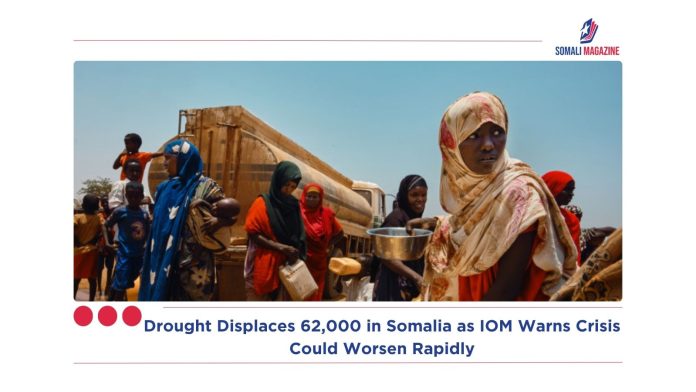
At least 62,000 people have been displaced in Somalia since the beginning of 2026 due to worsening drought conditions, according to the International Organization for Migration (IOM), which has warned that the situation could deteriorate further in the coming months. The scale of displacement highlights the intensifying impact of climate shocks across the country.
Data from the IOM indicates that drought now accounts for roughly three out of every four new displacements in Somalia, reflecting a significant increase compared to previous years. The agency has attributed the trend to prolonged dry conditions, failed rains, and the depletion of water sources, which have severely disrupted livelihoods, particularly among pastoral and farming communities.
The drought displaces 62,000 in Somalia crisis has affected multiple regions, including Baidoa, Dayniile, Kahda, Diinsoor, and Doolow, where crop failures, livestock losses, and water shortages have forced families to leave their homes in search of basic necessities. According to IOM officials, these movements are often a last resort for communities facing the collapse of traditional sources of income and food.
IOM has warned that the situation may worsen even if seasonal rains perform at expected levels. Projections from its Displacement Tracking Matrix suggest that an additional 125,000 people could be displaced by June if current conditions persist. The agency has emphasized that climate-related displacement is likely to intensify unless sustained humanitarian and resilience-focused interventions are implemented.
Humanitarian concerns are also growing in areas receiving displaced populations. Many families are moving to urban centres and informal settlements that are already under pressure, where access to shelter, clean water, sanitation, and healthcare remains limited. Aid agencies warn that these conditions increase vulnerability, particularly for women, children, and the elderly.
The drought is part of a broader regional crisis affecting the Horn of Africa, where repeated failed rainy seasons have compounded food insecurity and economic hardship. Recent assessments by humanitarian organizations indicate that millions of people in Somalia are already facing acute hunger, with funding shortages further constraining relief efforts.
Officials and experts have stressed the need for urgent action to address both immediate humanitarian needs and longer-term resilience. This includes investment in water infrastructure, climate-adaptive agriculture, and sustainable livelihoods to reduce vulnerability to future shocks.
While the full trajectory of the crisis remains uncertain, the drought displaces 62,000 in Somalia situation underscores the growing link between climate change and displacement. Without coordinated national and international responses, aid agencies warn that the humanitarian impact is likely to deepen in the months ahead.