Facebook

Twitter (X)

Instagram

Somali Magazine - People's Magazine
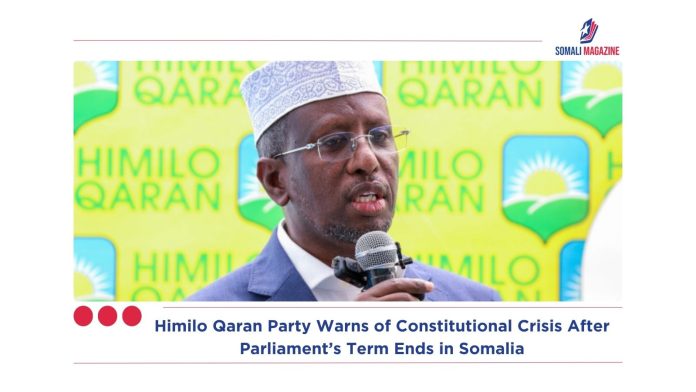
The statement that the Himilo Qaran Party warns of constitutional crisis has added urgency to Somalia’s evolving political situation, following the official end of Parliament’s mandate. The party, led by former President Sharif Sheikh Ahmed, cautioned that the absence of a functioning legislature could trigger a constitutional crisis Somalia is ill-prepared to handle amid ongoing Somalia election delays.
In a public address, Himilo Qaran officials stressed that the expiry of Parliament’s term without a clear transition plan undermines the constitutional framework designed to guide governance. The party argued that the delay in renewing legislative authority creates uncertainty over the legality of government actions, raising serious questions about institutional legitimacy and accountability.
Somalia Parliament term ends at a time when the country is already grappling with complex electoral challenges. The indirect electoral model, which relies on clan delegates and regional coordination, has repeatedly faced delays due to political disagreements and security concerns. While federal authorities have maintained that efforts are ongoing to finalize the electoral process, critics say the lack of concrete timelines has deepened public skepticism.
The warning from Himilo Qaran reflects broader anxieties shared by opposition groups and civil society organizations. Legal analysts note that without a sitting Parliament, key constitutional functions—including oversight of the executive and legislative decision-making—are effectively suspended. This gap, they argue, could contribute to a governance crisis Somalia has struggled to avoid in previous transitional periods.
Government representatives have responded cautiously, emphasizing that continuity measures are being considered to prevent institutional paralysis. Some officials have pointed to past precedents where transitional arrangements were implemented to maintain stability. However, the absence of a universally accepted framework has fueled concerns about potential political instability Somalia could face if consensus is not reached quickly.
The phrase Himilo Qaran Party warns of constitutional crisis has gained traction across political discourse, signaling a growing recognition that the situation extends beyond routine delays. Observers highlight that Somalia’s fragile political architecture depends heavily on adherence to constitutional norms, particularly in moments of transition. Any deviation, they warn, risks setting a precedent that could weaken democratic processes over time.
International stakeholders have also taken note of the developments. Somalia’s partners, including regional bodies and donor nations, have consistently emphasized the importance of timely and credible elections. Diplomatic sources suggest that prolonged uncertainty could affect international confidence, particularly in relation to governance reforms and state-building efforts.
Despite the tension, there remains a window for resolution. Political leaders across the spectrum have historically managed to negotiate compromises during critical junctures. Analysts suggest that renewed dialogue among federal and regional actors will be essential in addressing both immediate concerns and the structural issues contributing to repeated election delays.
As the country navigates this delicate phase, the warning that the Himilo Qaran Party warns of constitutional crisis underscores the urgency of decisive action. The coming days are likely to test Somalia’s political resilience and its commitment to constitutional order, with outcomes that could shape the nation’s governance trajectory for years to come.