
Facebook

Twitter (X)

Instagram

Somali Magazine - People's Magazine
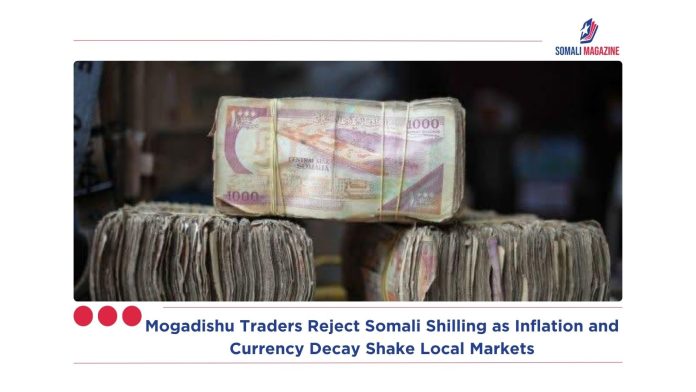
In a striking sign of deepening economic strain, Mogadishu traders are increasingly refusing to accept the Somali Shilling, citing runaway inflation and severe currency depreciation. The move, now spreading across key markets in the capital, underscores growing concerns about the stability of Somalia’s fragile financial system and highlights the challenges facing both businesses and consumers.
The Somali Shilling, once the backbone of everyday transactions, has steadily lost value over the years. With limited central bank control and the widespread circulation of counterfeit notes, confidence in the currency has eroded. Many traders now prefer payments in US dollars or mobile money platforms linked to more stable currencies, leaving the Somali Shilling sidelined in daily commerce.
Market vendors in Mogadishu say the decision is driven by survival rather than choice. Rapid inflation in Somalia has made it difficult to price goods consistently, with the value of the Somali Shilling fluctuating sharply even within short periods. Traders report frequent losses when accepting cash that depreciates before they can restock inventory. As a result, rejecting the local currency has become a protective measure against further financial uncertainty.
Economists note that Somalia’s prolonged lack of a fully regulated monetary system has contributed to the crisis. The absence of widespread trust in official currency issuance, coupled with decades of conflict and institutional weakness, has allowed informal financial practices to dominate. Mobile money services, widely used across the country, have partially filled the gap, but they also reinforce reliance on foreign currencies such as the US dollar.
Government authorities and the Central Bank of Somalia have previously acknowledged the issue, launching efforts to reform the currency system and combat counterfeiting. However, progress has been slow, and implementation challenges remain significant. Experts argue that restoring confidence in the Somali Shilling will require comprehensive reforms, including tighter monetary controls, improved banking infrastructure, and stronger regulatory oversight.
For ordinary citizens, the shift away from the Somali Shilling is creating new hardships. Those without access to dollars or digital payment systems find themselves excluded from certain markets, exacerbating inequality and limiting purchasing power. Small-scale traders and low-income households are particularly vulnerable, as they rely heavily on cash transactions.
The growing rejection of the Somali Shilling also raises broader concerns about economic stability in Somalia. A dual-currency system, where foreign currencies dominate, can weaken national monetary policy and reduce the government’s ability to manage inflation effectively. It also exposes the economy to external shocks, as reliance on the US dollar ties local markets more closely to global financial fluctuations.
Despite these challenges, some analysts see an opportunity for reform. The current crisis could serve as a turning point, prompting stronger policy action and renewed focus on rebuilding trust in the national currency. For now, however, Mogadishu traders continue to adapt to an uncertain landscape, navigating a market where the value of money itself remains in question.