
Facebook

Twitter (X)

Instagram

Somali Magazine - People's Magazine
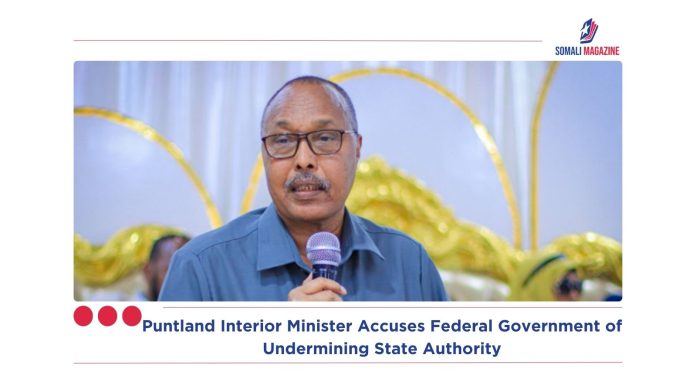
The Puntland Interior Minister has publicly accused the Somalia federal government of deliberately undermining the authority and autonomy of Puntland state, intensifying an already fragile political relationship between regional and central authorities. The remarks, delivered amid growing Somalia political tensions, reflect deeper structural disagreements over governance and federalism in Somalia.
According to statements from Puntland officials, the dispute centres on what they describe as repeated interference by the Somalia federal government in the internal affairs of the semi-autonomous region. The Puntland Interior Minister argued that such actions violate the principles of federalism in Somalia, which are meant to guarantee regional states a degree of independence while maintaining national unity.
The accusations come at a time when relations between Puntland state and the federal government have been strained over constitutional interpretation, resource sharing, and security coordination. Puntland, one of Somalia’s oldest federal member states, has historically positioned itself as a strong advocate for decentralised governance. However, officials in Garowe have increasingly voiced concern that the federal government is consolidating power at the centre.
Analysts say the latest remarks highlight a broader Somalia governance crisis, where unclear constitutional frameworks continue to fuel disputes between Mogadishu and regional administrations. The provisional constitution, adopted in 2012, outlines a federal structure but leaves several key issues unresolved, including the division of powers and revenue-sharing mechanisms.
In recent years, tensions have also emerged around electoral processes and security operations. Puntland authorities have, on multiple occasions, resisted federal directives, arguing that decisions affecting the region should involve local leadership. The Puntland Interior Minister reiterated this stance, emphasising the need for dialogue and mutual respect between federal and state institutions.
Officials from the Somalia federal government have not issued a detailed response to the latest accusations but have previously maintained that their actions are aimed at strengthening national cohesion and ensuring consistent governance across the country. Federal leaders often argue that a unified approach is necessary to address security threats, including the ongoing fight against extremist groups.
The dispute underscores the delicate balance Somalia faces as it continues to rebuild state institutions after decades of conflict. While federalism was introduced as a solution to longstanding clan and regional divisions, its implementation has proven complex. Competing interpretations of authority have frequently led to political standoffs, slowing progress on key national priorities.
For citizens, the political friction risks diverting attention from pressing issues such as economic recovery, security, and public service delivery. Observers warn that without sustained dialogue and clearer constitutional guidelines, disagreements between Puntland state and the federal government could deepen, further complicating Somalia’s path toward stability.
Despite the tensions, there are calls from civil society groups and policy experts for renewed negotiations. Many stress that constructive engagement between regional and federal leaders is essential to resolving disputes and strengthening governance frameworks. As the situation unfolds, the statements by the Puntland Interior Minister serve as a reminder of the ongoing challenges in defining and maintaining Somalia’s federal system.