Facebook

Twitter (X)

Instagram

Somali Magazine - People's Magazine
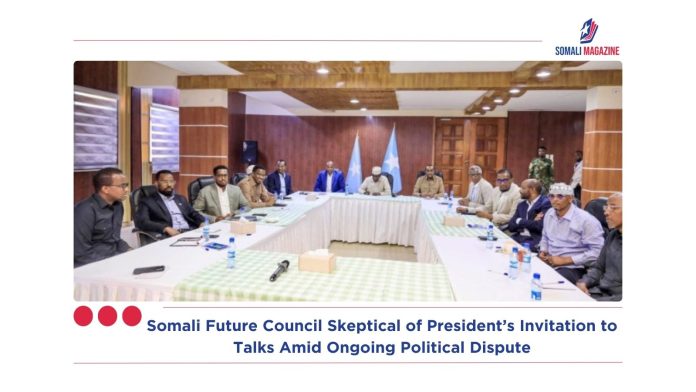
The issue of the Somali Future Council skeptical of President’s invitation to talks has emerged as a key development in Somalia’s evolving political landscape, highlighting ongoing tensions between the federal government and opposition groups. According to recent reports, President Hassan Sheikh Mohamud invited the opposition-aligned Somali Future Council to participate in a national consultative meeting scheduled for May 10, aimed at addressing critical national priorities including elections, governance, and unity.
However, early responses from opposition figures suggest hesitation and conditional engagement. Reports indicate that members of the Somali Future Council have questioned the intent and structure of the proposed talks, with some representatives reportedly rejecting the invitation unless key concerns—particularly around electoral processes and constitutional changes—are addressed.
The Somali Future Council, formed in 2025 as a coalition of opposition leaders and regional stakeholders, has positioned itself as a major political bloc challenging aspects of the federal government’s reform agenda. The group has been particularly critical of recent constitutional amendments and proposed electoral models, which it argues lack broad consensus and could undermine the consultative framework traditionally used in Somalia’s political processes.
The invitation to talks comes at a sensitive moment, as Somalia faces mounting uncertainty linked to the electoral timeline and the approaching end of the president’s current term. According to analysts and diplomatic observers, disagreements over election models—particularly the debate between direct universal suffrage and indirect voting systems—remain a central point of contention.
International partners, including the United Nations Transition Mission in Somalia (UNTMIS), have welcomed the proposed dialogue, describing it as an opportunity to build consensus and address unresolved political issues. In its statement, the UN urged all stakeholders to engage constructively and in good faith, emphasizing that national interests should take precedence over political divisions.
Despite this international support, it remains unclear whether the Somali Future Council will fully participate in the planned discussions. Previous rounds of dialogue between the government and opposition groups have encountered setbacks, often due to disagreements over agenda-setting, procedural frameworks, and trust between parties.
Observers note that the current situation reflects broader challenges within Somalia political dialogue mechanisms, where competing priorities and institutional disagreements continue to slow progress. The outcome of the proposed talks may have significant implications for Somalia election dispute 2026 and the country’s broader state-building efforts.
As of now, the position of the Somali Future Council underscores the complexity of achieving consensus in a fragmented political environment. While the invitation signals an attempt at renewed engagement, the response from opposition groups suggests that substantial differences remain unresolved.