
Facebook

Twitter (X)

Instagram

Somali Magazine - People's Magazine
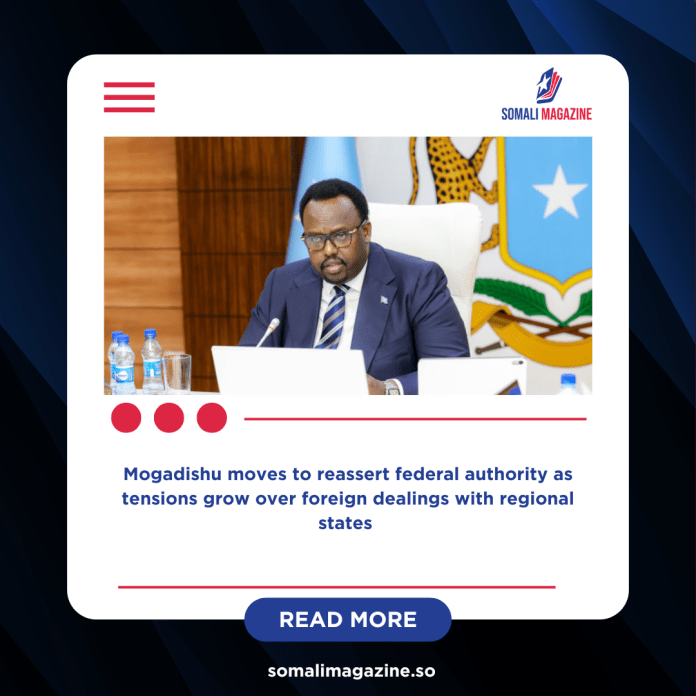
Somalia’s federal cabinet has announced that it has cancelled all agreements previously signed with the United Arab Emirates, including deals related to defense cooperation, port operations, and security assistance. The decision marks a major escalation in a long-running dispute between Mogadishu and Abu Dhabi over the UAE’s direct engagement with Somalia’s regional administrations without the approval of the federal government.
According to government officials, the move was taken after what they described as repeated violations of Somalia’s sovereignty. They accused the UAE of signing agreements with regional authorities while sidelining the federal government, a practice Mogadishu says clearly violates the country’s provisional constitution. Under the constitution, matters relating to foreign relations and international agreements fall exclusively under the authority of the federal state.
The cabinet’s decision came at a sensitive moment, as officials confirmed that the UAE had begun withdrawing some of its military assets from Somalia. This followed a recent ban imposed by Mogadishu on Emirati military and cargo flights entering Somali airspace. The government said the restriction was necessary due to concerns over the use of strategic airfields and the expansion of foreign security operations without federal oversight or coordination.
Members of the cabinet said the annulment of the agreements was intended to restore national authority over key partnerships and critical infrastructure. They stressed that Somalia must deal with foreign governments and investors through a single, unified framework to avoid fragmentation and conflicting interests. At the same time, officials admitted that enforcing the decision could prove challenging, especially in regions where UAE-backed projects are already active and deeply embedded in local economies.
The dispute has been unfolding against a backdrop of shifting regional alliances, particularly involving Somaliland. Earlier this month, Israel’s foreign minister visited Hargeisa shortly after Israel announced its decision to recognize Somaliland’s claim of independence. The move was strongly condemned by Somalia’s federal government, which said it violated the country’s sovereignty and territorial integrity.
Mogadishu reiterated that Somaliland, which declared independence in 1991, remains an integral part of Somalia under international law. Authorities in Hargeisa, however, welcomed Israel’s announcement, describing it as an opportunity to strengthen diplomatic, economic, and security ties. Somaliland officials also denied reports suggesting that the relationship would involve the establishment of foreign military bases or the relocation of refugees to the region.
For years, the UAE has been Somaliland’s most influential external partner. Abu Dhabi maintains a trade mission in Hargeisa and has supported major infrastructure projects, most notably the expansion of Berbera port. The port is operated by DP World, a global port management company based in Dubai. Berbera’s strategic location along major shipping routes linking the Red Sea and the Indian Ocean has made it increasingly important to regional and international trade.
Somalia’s federal government has consistently opposed such arrangements, arguing that they undermine constitutional authority and strengthen Somaliland’s efforts to gain international recognition. Similar tensions have arisen in other regions, including Puntland, where the UAE has supported port development and maritime security initiatives, and Jubaland, where Mogadishu has raised concerns about foreign security assistance provided directly to regional administrations.
Political analysts say the cabinet’s decision reflects a deeper struggle over power, resources, and control of foreign engagement within Somalia’s federal system. Federal leaders insist that all international agreements must be negotiated and approved in Mogadishu to preserve national unity. Regional authorities, on the other hand, argue that ongoing security threats and economic pressures leave them little choice but to engage directly with foreign partners.
The cancellation of the UAE agreements is expected to further strain relations between the federal government and Somalia’s regional administrations. It also adds another layer of complexity as Somalia seeks stability, foreign investment, and international support at a time when alliances in the Horn of Africa are rapidly shifting.